Built for a genuine two-season problem
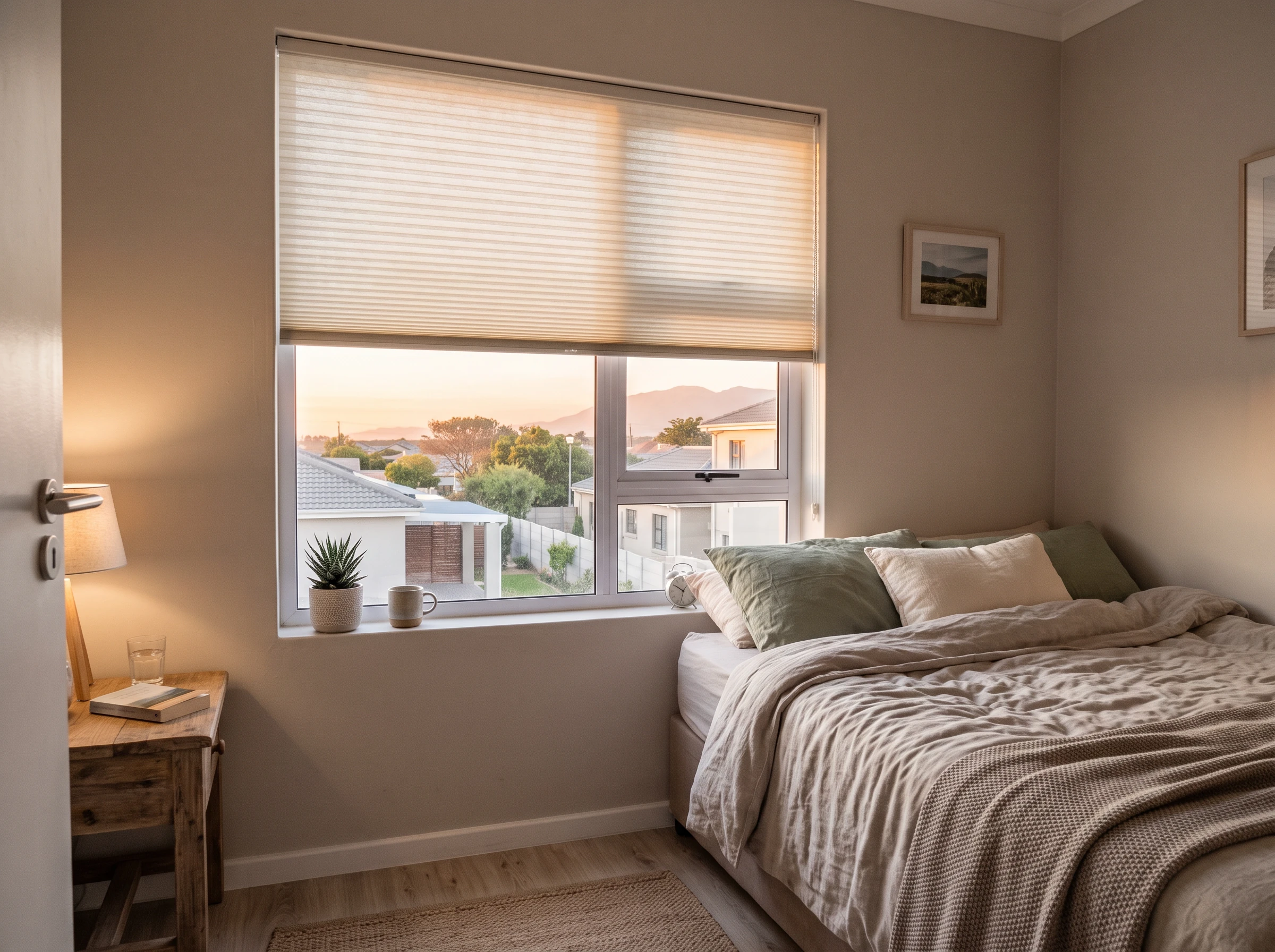
Kraaifontein runs hot and dry through summer — February is the hottest month here — and cool and wet through winter, with June and July the wettest. A pleated cellular blind traps a layer of still air in hexagonal cells against the glass, which works as insulation in both directions: it dulls the summer heat coming in and holds a room's warmth in on a damp winter night. That's genuinely useful in a compact new-estate bedroom that doesn't have much thermal mass to begin with, and just as useful in an older Windsor Park room over a garage that's always the coldest spot in the house.
Top-down/bottom-up for a street-facing room
New-estate stands often sit close to the pavement, and a bedroom window facing straight onto the street wants privacy at eye level without losing the sky above it. A top-down/bottom-up cellular blind covers the bottom of the window for privacy while leaving the top open for daylight — a common spec on Kraaifontein's newer, tighter-set estate frontages.
The smallest stack, the quietest room
Because the pleats compress into a slim stack when raised, cellular blinds leave more of the glass genuinely clear than almost any other product, and the same trapped-air structure takes a little of the edge off outside noise too — worth knowing on a Kraaifontein estate street where houses and driveways sit close together.
Cellular blinds are the one product we recommend on both a February afternoon and a July morning, which tells you something about this climate.
On-site measure, Kraaifontein- Light-filtering or blockout cell fabrics
- Top-down/bottom-up operation for street-facing rooms
- Cordless and motorised options, child-safe as standard
- Single or double cell, for mild rooms or serious thermal work
What a honeycomb blind costs
Cellular fabric is pleated into air cells, so there is more material and more assembly in it than a flat sheet, and the guide reflects that: R1,500 to R2,800 per square metre installed hand-operated, and R3,000 to R4,800 motorised. Double-cell fabric, a top-down bottom-up header and side channels all move a window towards the upper end of its band.
Small openings carry a minimum charge, and a tall stairwell drop is quoted on its own because the cord run and the fixing are the work rather than the fabric. Nothing is final until the free measure, and the written quote is itemised per window before any order goes in.
Ready to measure your windows?
Free measure at the house, every window priced on its own line, and nothing owed if you decide against it.