Home / The Guide
The wind turns in May
Kraaifontein runs on two halves of a year, and the wind draws the line between them. A south wind dominates from September to May, on 54% of days in January alone. A north wind takes over from May to August.2 Almost everything worth knowing about shading a house here follows from that one fact. Free to read, fully sourced, nothing to sign.
Prefer to read this on paper, or keep it? Download the whole guide as a PDF (1.0 MB).
Why a wind, and not a compass, organises this guide
Most shading advice starts with the four points of the compass. In Kraaifontein that is the wrong place to begin, for a reason that is specific to this town: the newer estates were laid out on a road grid rather than to the sun, so the aspect of your living-room glass was decided by where the tar went. Two identical sliding doors, four houses apart, can face completely different directions. You cannot generalise from the plot number, and neither can we.
What is the same for every house here is the weather, and the local weather has an unusually clean split. Kraaifontein is windy all year — the average wind speed runs around 24 km/h — but the direction flips with the season. The south wind (the Cape Doctor, the south-easter) prevails from September through May and peaks at 54% of days in January. From May to August a north wind takes over, peaking at about 38% of days in late June, arriving with the winter rain fronts.2
So the year has a summer half and a winter half, they want opposite things from your windows, and May is the hinge. That is how this guide is arranged.
The summer half — September to May
February is the hottest month here, with highs around 28 °C, and it is also the driest, at roughly 13 mm of rain for the month.2 Long, dry, bright afternoons — and a sun whose geometry does not care which way the road planner pointed your stand.
Three numbers, which you can check for yourself. Kraaifontein sits at about 33.84° south, so solar-noon altitude works out to roughly 79.6° at the December solstice, 56.2° at the equinoxes, and 32.7° at the June solstice.3 The consequence that matters in summer is not the noon figure at all — it is what happens after four, when the sun drops below the height of your eaves and starts arriving sideways.
The window that costs you money
A west-facing living room here is the one that ends up in the enquiry. It is fine at noon, because at nearly 80° the sun is almost overhead and the roofline handles it. By late afternoon the same roofline is useless — low sun comes in under it, straight through the glass, and keeps coming for hours.
The honest physics: an interior blind on west glass is working on light that is already inside the building. The pane has taken the energy first, the fabric takes what is left, and the room gets both of them back through the evening. As glare control it earns its money. As heat control on a big west opening it does not.
Heat has to be caught outside the glass. On Kraaifontein's west elevations, in the order we usually recommend them:
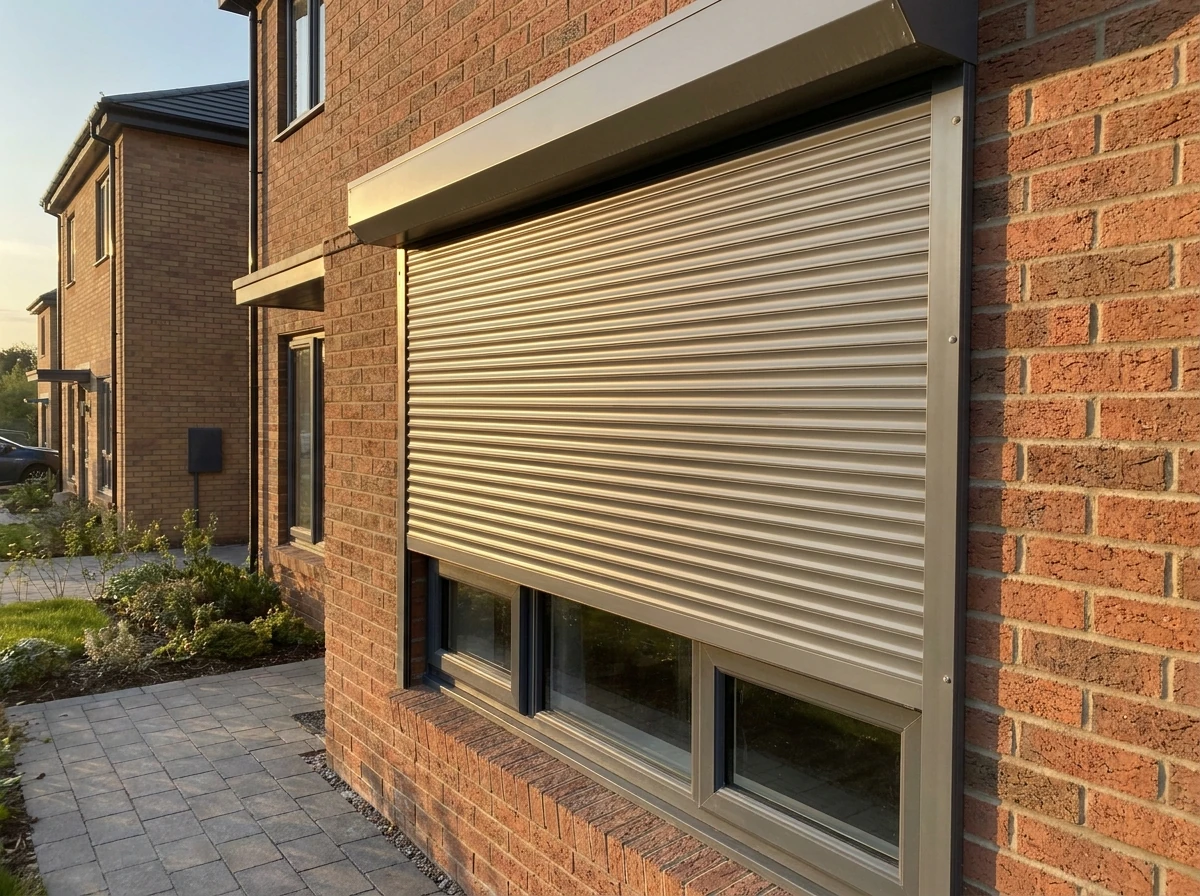
- Roller shutters — a curtain of interlocking aluminium slats that winds down on the outside of the window. The strongest heat and light control we fit, and the steadiest thing you can put on an exposed wall in a January south-easter. To be blunt about it: the job is sun, heat, glare and dark. There is no security rating involved, and anyone telling you otherwise is describing a different product — one we can also quote, separately.
- External venetian shading — wide aluminium blades outside the glass that you tilt or lift through the day. It gives you the heat rejection of an exterior product without giving up the view, which is why it wins on a living room you actually sit in.
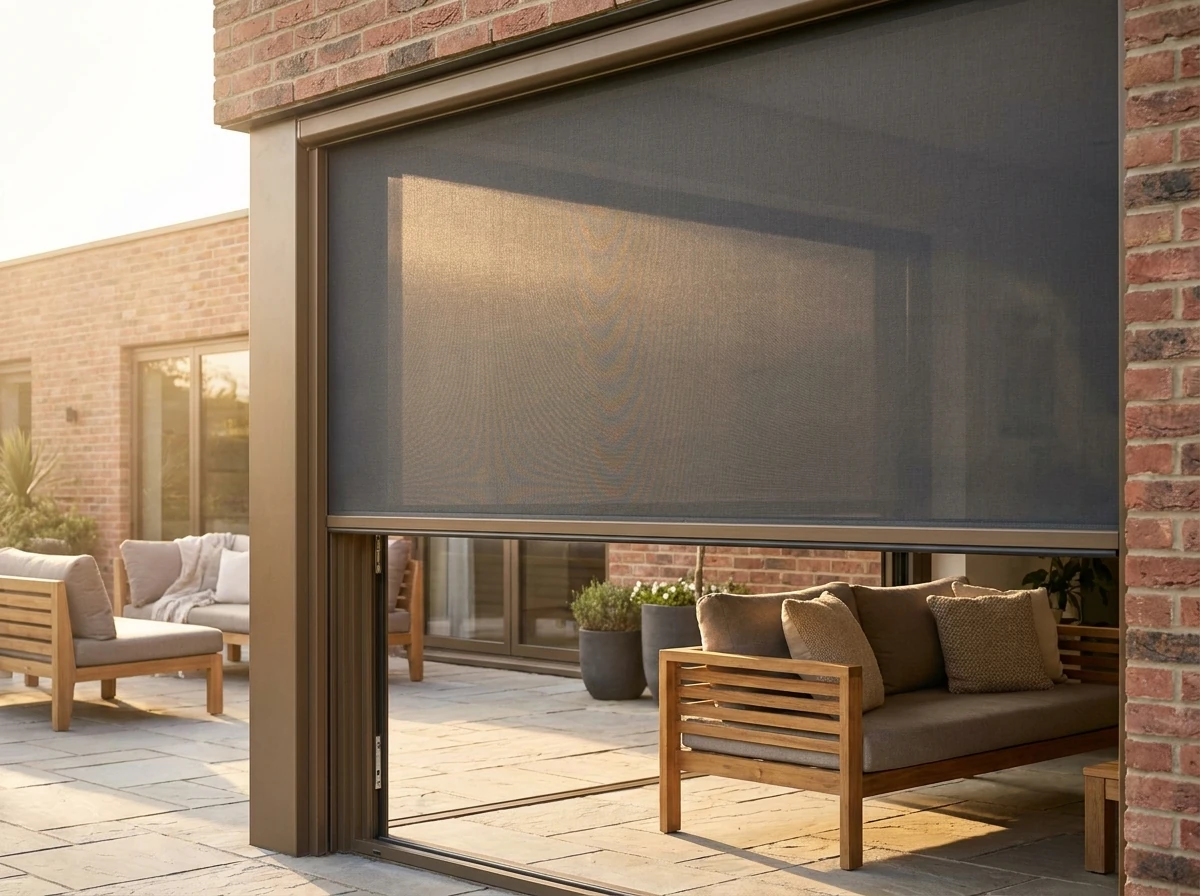
- Zip screens — mesh tensioned into aluminium side channels. The answer for a patio rather than a window, and specifically the answer where the wind is what makes the space unusable.
Where an exterior fixing is not on the cards — budget, a rented house, a complex with a say over the facade — a tight-weave sunscreen, or mesh and blockout paired on one bracket, is the honest interior fallback. Better than nothing by a wide margin, not the same thing, and we will not tell you otherwise.
January, and the patio problem
January is the peak of the south wind, on more than half the days of the month.2 It is also, inconveniently, the middle of braai season, when a Kraaifontein back garden is doing its hardest work of the year.
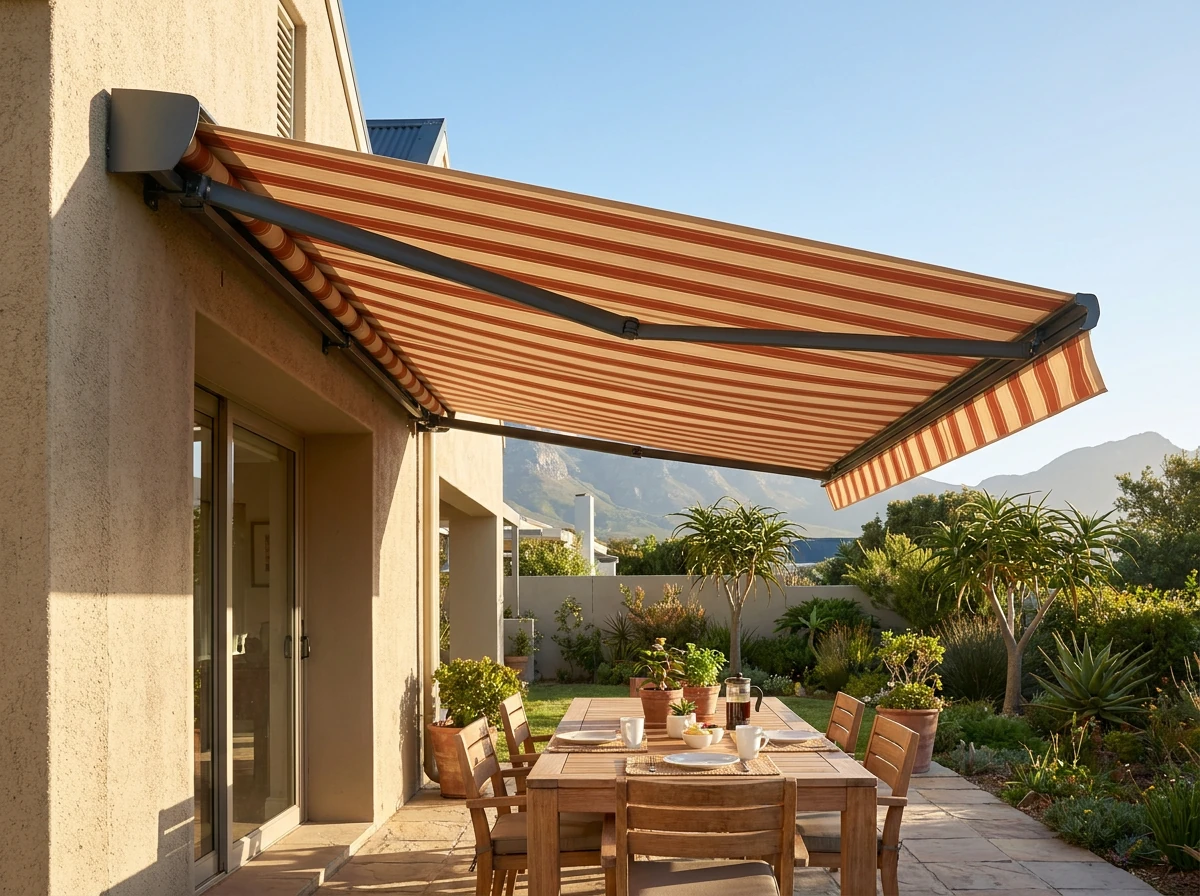
This is where the choice between an awning and a screen is a genuine decision rather than a preference. A folding-arm awning is the better product when what you want back in winter is the open sky — it retracts to nothing. A zip screen is the better product when wind is the thing spoiling the space: the mesh is held in channels down both sides, so it holds its shape instead of flapping, and it takes the wind out of an outdoor room without walling it in.
The one rule we do not bend
Motorised, outside, and on an open stand — that combination gets a sensor, every time. It draws the fabric in ahead of the gust rather than waiting for somebody to react. In a courtyard the wind never really reaches we will say so and let you spend the money elsewhere; on an open new-estate stand in January it is the difference between a product that lasts and one that does not.
May — the turn
May is the crossover month: the south wind fades and the north wind takes over.2 Practically, it is also the month when the house stops being a heat problem and starts being a warmth problem, and the specification you would have written in January quietly becomes the wrong one.
This is the argument for not over-fixing in summer. The most common mistake we see is heavy blockout fitted across a north-facing living room during a February heatwave. Come June, that same low winter sun — sitting at only about 32.7° at noon, and reaching metres into the room3 — is free heat you have just switched off. North glass wants something adjustable, not an off switch.
The winter half — May to August
June is the wettest month at roughly 94 mm, with July close behind at about 89 mm. July is also the coolest: highs near 17 °C, lows near 7 °C.2 The rain arrives on the north-westerly fronts that give the winter half its wind direction.
Two things change in the specification.
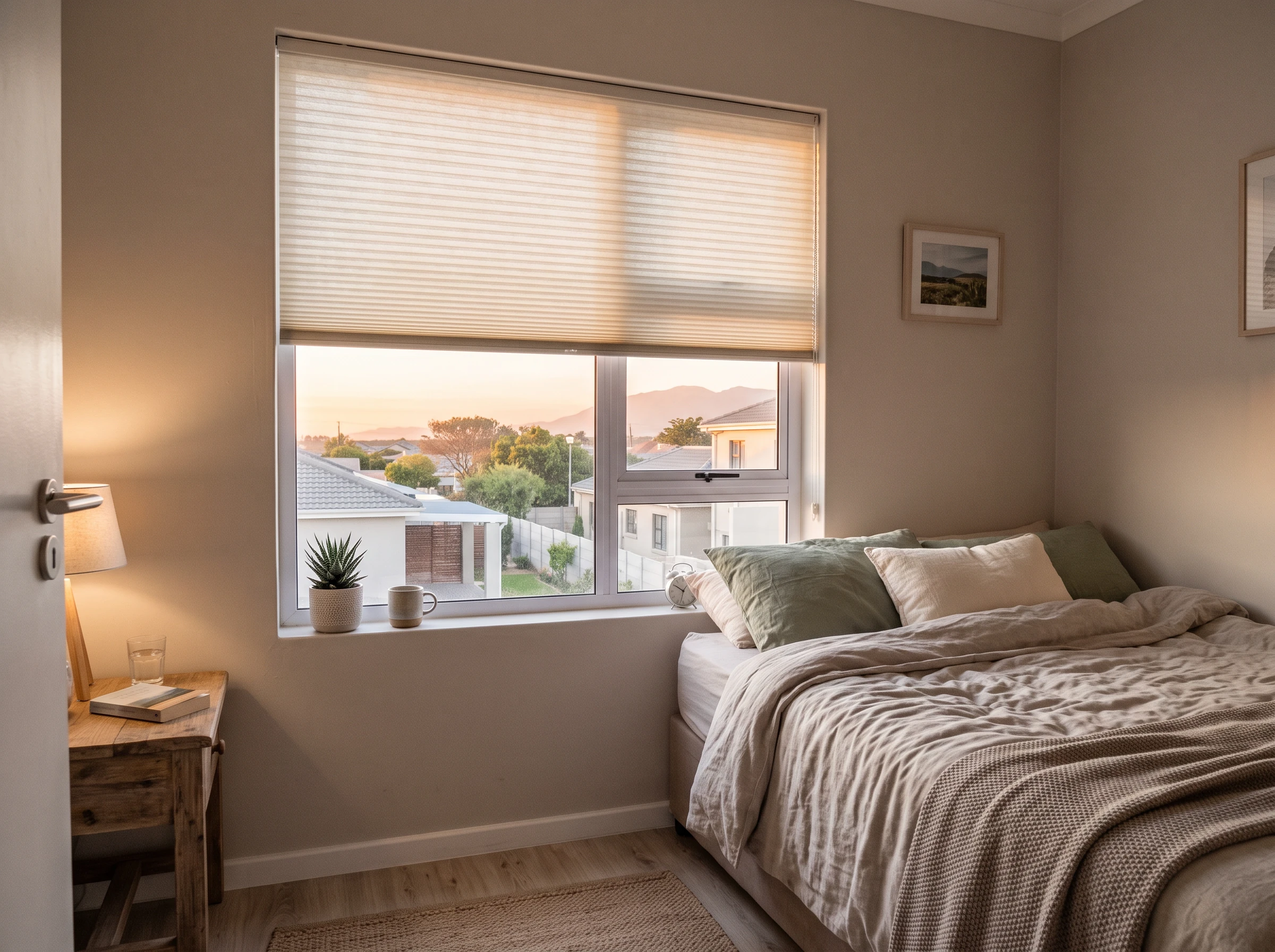
- Insulation beats shading. In the rooms that run cold — a south-facing bedroom, a study over the garage, a compact new-estate room with a big window and a small volume — a cellular honeycomb blind does something a flat fabric cannot: the air trapped inside the cells is the insulator. It is a temperature product, not a light product, and it is the right one here.
- Damp, not salt, is what wrecks hardware. Kraaifontein is about 31 km inland, roughly halfway between Cape Town and Paarl on the N11 — the salt-air corrosion story belongs to the coastal suburbs, not here. What does bite is winter condensation in low-airflow rooms, which is why we default to sealed aluminium slats rather than timber in bathrooms, kitchens and sculleries. Timber stays for the warm, dry rooms it looks best in.
Two kinds of house, one town
Kraaifontein grew out of subdivided farmland from 1869, gained a railway junction in 1876, and was its own municipality until it was absorbed into the Cape Town metro in the late 1990s — which is why it still reads as a town with its own centre rather than an offshoot of a neighbour. The name is straightforward Afrikaans: kraai, crow, and fontein, spring.1
That long history shows up as two very different jobs on the same enquiry list:
- New compact estates — Zonnendal, Camelot, and the newer stock around Northpine and Scottsdene. Handover in South Africa means bare glass on day one, so window treatments here are an immediate purchase rather than a someday one. The openings are square and true, which makes fitting simple; the aspect is whatever the road grid gave you, which makes specification the hard part. Buyers who have already paid for estate security and solar hot water tend to want motorised, scheduled blinds rather than a chain to manage.
- Established family suburbs — Windsor Park and Zoo Park, with roughly 600 m² stands and the generous living-room glass of 1970s-to-1990s Cape family houses.4 Older aluminium sliders and casements on frames that have settled a little; a bracket that would go straight into a new estate wall sometimes needs a different fixing here. That is a measure-on-site problem, not a catalogue problem.
What both share: a west-facing room somebody avoids between four and seven in February, and a cold room somebody avoids in July.
One limit worth knowing before you order
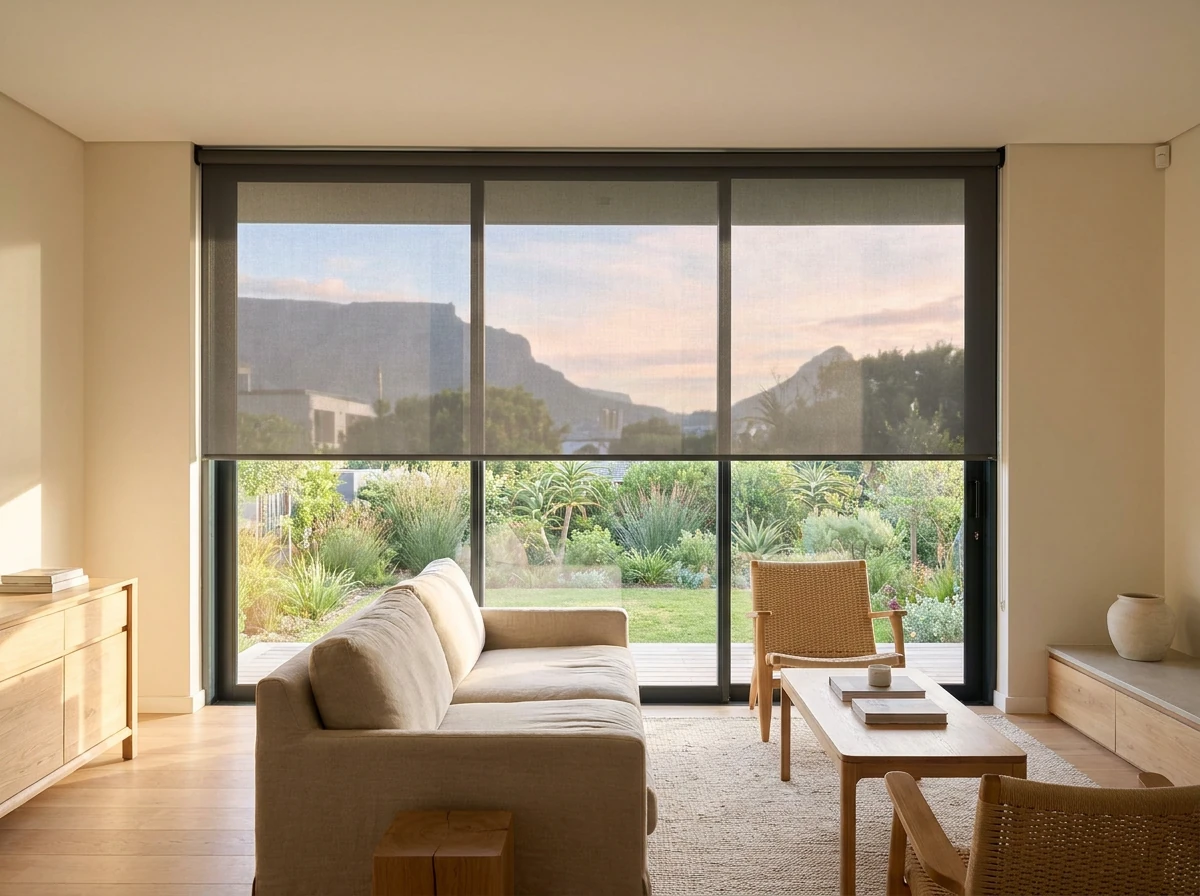
Mesh buys privacy only while it is brighter outside than in. Reverse those two — lamps on, street dark — and the room is on display. On an open estate road with nothing grown up yet to soften the sightlines, it is the complaint that brings us back to a house more often than any other — and putting a blockout layer behind the mesh on the same bracket at the start removes it entirely.
What a wind rose cannot tell you about your own stand
Everything above is true of Kraaifontein. These five are true only of your house, and any one of them can change the recommendation:
- The compass reading for every room. On a road-grid estate this is the single most important measurement of the lot, and a phone settles it in ten seconds a room.
- How much wind the stand really takes. A corner plot with open veld behind it and a mid-block house tucked behind two neighbours are different jobs in the same January.
- Reveal depth and squareness. New estate openings are true; a settled older frame may not be, and that decides inside-fit versus a face-fixed cassette.
- The build-up of the wall itself. It sets the fixing, and it is what says yes or no to an exterior system.
- The electrics. Whether there is a point close enough for a motor, and how a rechargeable tube would be got at on a tall window.
That is what the free measure is actually for. Answer those five first and the quote is right; answer them afterwards and something gets rebuilt.
Have the guide read for your own stand
One visit: samples in hand, compass out, every opening measured, and a quote written per window before you decide anything. Free, no obligation.
Which half of the year brought you here?
Tell us the rooms and what they do wrong. One of our expert consultants will contact you shortly to arrange your free in-home measure.
- No obligation, no call-centre — a consultant calls you directly
- Orientation confirmed on site, never assumed from the plot number
- Written, itemised quote before anything is ordered
Sources
Everything factual on this page came from the list below. Sun angles are worked out from Kraaifontein's latitude using standard solar geometry — the method is set out in the text — rather than lifted from any single page. Where a claim would not stand up to checking, we left it out.
- Wikipedia — Kraaifontein: founded on subdivided farmland from 1869, with a railway junction from 1876; its own municipality until incorporation into the Cape Town metro in the late 1990s; the name from Afrikaans kraai (crow) and fontein (spring); position on the N1 roughly halfway between Cape Town and Paarl, bordered by Brackenfell and Durbanville.
- Weather Spark — Average weather in Kraaifontein, year round: February the hottest month with highs around 28 °C and the driest at roughly 13 mm; July the coolest with highs near 17 °C and lows near 7 °C; June the wettest at roughly 94 mm with July close behind at about 89 mm; windy year round with an average speed near 24 km/h; a south wind prevailing September to May and peaking at 54% of days in January, a north wind prevailing May to August and peaking near 38% in late June.
- Solar altitudes for latitude ≈33.84° S, worked out with the standard noon formula: start at 90°, take away how far the latitude sits from the sun's declination on the day, and remember the declination itself runs out to ±23.44° at the solstices. That gives about 79.6° in December, 56.2° at the equinoxes and 32.7° in June. The underlying almanac is timeanddate.com's Cape Town sun page.
- Chas Everitt — Kraaifontein area profile: Windsor Park and Zoo Park as established family suburbs on roughly 600 m² stands; Zonnendal as the focus of the area's new development, with Northpine and Scottsdene adding further stock; the town's own retail and school spine.
- Background on the south-easter from Wikipedia and Cape Town Magazine. It is the same wind that shows up in source 2 as the south-direction share of days.
The specifications above are our opinion, given free of charge. They are not permission to build: where a homeowners' association or a complex governs what may go on the outside of a house, that authority is theirs, and we confirm it up front rather than after an order.